
Choosing between HR sheet plate and cold rolled plate can feel like standing at a crossroads. One wrong turn, and you might end up with material that doesn’t fit your budget, delays your project, or requires expensive rework. But here’s the good news: once you understand how these two steel types differ, the decision becomes crystal clear.
Let me walk you through everything you need to know, just like I’d explain it to a friend over chai.
What Exactly Are HR Sheet Plate and Cold Rolled Plate?
Think of steel manufacturing like baking bread. Hot rolled (HR) steel is like fresh-baked roti straight off the tawa—shaped while hot, cooled naturally, and ready to use. Cold rolled (CR) steel? That’s like rolling out the dough again after it cools, making it thinner, smoother, and more refined.
Hot Rolled Steel (HR Steel)
is produced by heating large slabs of carbon steel above 1,700°F (926°C) and passing them through rollers at the steel mill. The high temperature makes the metal pliable, allowing it to be shaped into thick plates and sheets. After rolling, it cools at room temperature.
Cold Rolled Steel (CR Steel)
starts as hot rolled steel but goes through additional processing. It’s rolled again at room temperature through precision mills, creating a smoother finish and tighter dimensional control.
HR vs CR Steel Comparison: The Key Differences
Let’s break down how these two materials stack up against each other.
| Feature | HR Sheet Plate | Cold Rolled Plate |
| Processing Temperature | Above 1,700°F (hot) | Room temperature (cold) |
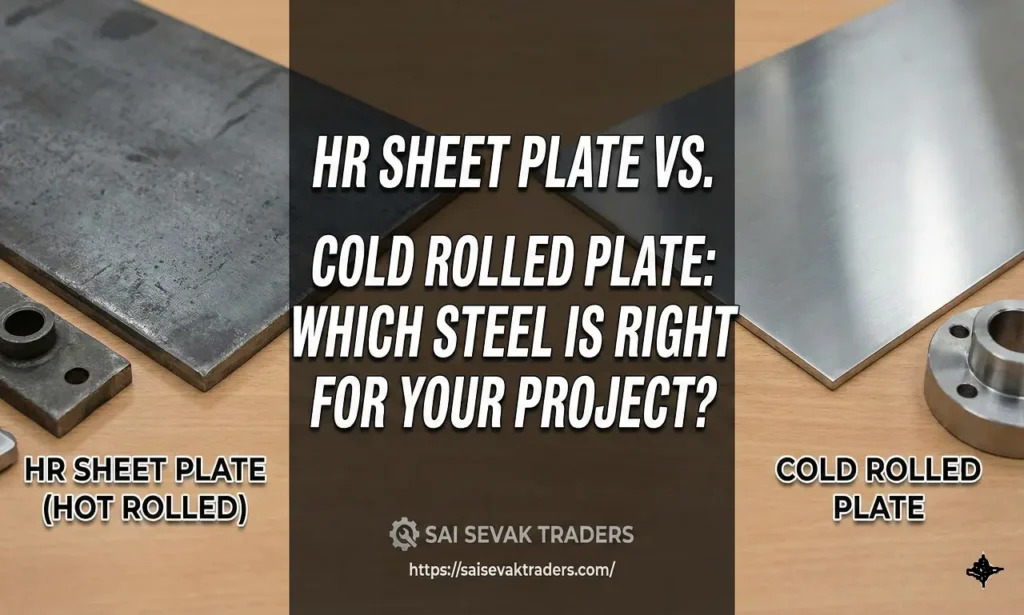
| Surface Finish | Rough, scaly texture | Smooth, polished surface |
| Thickness Tolerance | ±0.25mm to ±0.50mm | ±0.05mm to ±0.15mm |
| Strength | Moderate (lower hardness) | Higher (work-hardened) |
| Cost | 10-20% cheaper | More expensive |
| Best For | Structural frames, tanks | Automotive parts, appliances |
How Does the Steel Rolling Process Affect Your Project?
The manufacturing route isn’t just technical jargon—it directly impacts your project’s success.
When HR steel cools naturally after hot rolling, the metal shrinks slightly. This creates small variations in thickness and a rough, oxidized surface layer (that characteristic blue-gray scale you’ve probably seen). It’s like letting dough rise naturally versus pressing it into a perfect mold.
Cold rolling eliminates these inconsistencies. The metal fabrication industry uses precision rollers to compress the steel at room temperature, removing surface imperfections and achieving exact dimensions. This work-hardening process also increases strength by 20-30%.
Hot Rolled Plate Properties: When Should You Choose HR Steel?
HR sheet plate shines in applications where raw strength and cost-effectiveness matter more than aesthetics.
Ideal Uses:
- Building construction frames and beams
- Railway tracks and heavy machinery bases
- Storage tanks and industrial equipment
- Agricultural machinery components
- Welding projects with thick material
I recently visited a construction site in Bhopal where contractors were using HR plates for structural supports. Why? Because the rough surface actually helps paint and coatings grip better. Plus, when you’re welding thick sections, HR steel’s ductility prevents cracking.
Hot Rolled vs Cold Rolled Thickness Tolerance: HR plates typically range from 2mm to 200mm thick. If your project needs material thicker than 3mm and appearance isn’t critical, HR steel is your budget-friendly champion.
Cold Rolled Steel Advantages: When Does CR Steel Win?
Cold rolled plates are the precision tools of the steel world.
Perfect For:
- Automotive body panels and doors
- Home appliances (refrigerators, washing machines)
- Furniture and office equipment
- Electronics enclosures
- Architectural details requiring clean lines
Why Choose CR Steel?
- Precision fit: Tighter tolerances mean parts fit together perfectly without grinding or filing
- Smooth finish: Ready for painting or powder coating without extra surface prep
- Higher strength-to-weight ratio: Thinner material with comparable strength
- Better formability: Ideal for stamping and complex bending operations
A metal fabricator I know in Mumbai switched from HR to CR sheet for his furniture line. The result? Customers loved the sleek finish, and he reduced paint consumption by 40% because the smooth surface needed fewer coats.
HR Sheet Plate vs Cold Rolled Plate Cost: The Real Numbers
Let’s talk money, because that’s often the deciding factor.
Cost Breakdown:
- HR sheet plate: ₹45-65 per kg (depending on thickness and grade)
- Cold rolled plate: ₹55-80 per kg
But here’s the catch—initial price tells only half the story.
Total Cost Considerations:
- Surface preparation: HR steel requires shot blasting or grinding (₹15-25 per kg extra)
- Paint coverage: Rough HR surfaces need 30-40% more paint
- Machining time: CR steel cuts cleaner, reducing tool wear
- Waste factor: Better tolerances mean less material rejected
For structural projects where finish doesn’t matter, HR steel saves 15-25% overall. For precision work, CR steel actually becomes cheaper when you factor in reduced finishing costs.
Difference Between Hot Rolled and Cold Rolled Steel: A Decision Framework
Still unsure which to choose? Ask yourself these questions:
Choose HR Sheet Plate if:
- Your project needs material thicker than 3mm
- Surface appearance isn’t critical
- You’re working on structural or load-bearing applications
- Budget is tight and volume is high
- Heavy welding is involved
Choose Cold Rolled Plate if:
- You need thin gauge material (under 3mm)
- Surface finish matters for aesthetics or painting
- Dimensional accuracy is critical for assembly
- You’re manufacturing consumer products
- Parts require stamping or complex forming
Where to Buy HR Plate at Best Prices in India
As trusted steel distributors at Sai Sevak Traders, we’ve helped hundreds of fabricators, contractors, and manufacturers choose the right material. Whether you need an hr plate distributor with consistent inventory or an hr sheet supplier in Bhopal with technical support, we’ve got you covered.
Pro Tip: When requesting quotes, always specify:
- Required thickness and dimensional tolerances
- Surface finish requirements (mill finish, pickled, or oiled)
- Quantity and delivery timeline
- Any special certifications needed
Understanding the hr sheet vs cr sheet comparison helps you avoid costly mistakes and project delays.
Frequently Asked Questions
Q: Is it possible to use hot-rolled plate instead of cold-rolled plate as a cost savings?
Certainly, if you do not require surface finish and tight tolerances. Hot-rolled plate is ideal for structural work. If it is a part that will be visible, or if it is an assembly with some degree of precision, the extra cost of cold-rolled plate will make it worth it, if to avoid expensive re-work later.
Q: How do I tell the difference between HR vs CR steel on-site?
Hot-rolled steel has a rough, scaly surface, with a blue-grayish color. Cold-rolled steel will appear darker (glossy) and smother, and almost look polished. Just run your hand over it and if it feels rough it is most likely hot rolled.
Q: Which steel is stronger?
Cold rolled steel is 20-30% stronger than hot rolled because of the work hardening during the cold rolling process . In the future durability, hot rolled steel will offer better ductility for welding and forming at higher temperatures.
Q: How do hr steel plate dimensions compare to cold rolled?
HR plates are typically 2mm-200mm thick, while CR plates normally max out at around 3-6mm thickness. As for width and length HR plate and CR plate are available in standard sizes; however, CR plates offer better dimension control.
Final Takeaway: Make the Smart Choice
Choosing between HR sheet plate and cold rolled plate isn’t about which is “better”—it’s about which fits your specific needs. HR steel delivers strength and economy for heavy-duty applications. CR steel provides precision and finish for products where appearance matters.
Need help selecting the right material for your next project? Contact Sai Sevak Traders today. We’ll match you with the perfect steel grade, thickness, and finish—at prices that make sense for your business.