
Ever stood in front of two steel sheets wondering which one to pick? You’re not alone. The HR sheet vs CR sheet debate confuses even experienced fabricators. Let me break it down for you in plain English—no engineering degree required.
What’s the Real Difference Between HR and CR Steel?
Think of hot rolled (HR) and cold rolled (CR) steel like bread from your kitchen. HR steel is like freshly baked bread straight from the oven—warm, soft, and a bit rough around the edges. CR steel? That’s the same bread, toasted and pressed in a panini maker—firmer, smoother, and more refined.
Hot rolled steel gets shaped at scorching temperatures (above 1,700°F), while cold rolled steel starts as hot rolled material but goes through additional processing at room temperature. This extra step makes all the difference in strength, finish, and price.
How Are HR Sheets and CR Sheets Actually Made?
The Hot Rolling Process
Picture a massive rectangular block of steel called a billet. It gets heated until it’s glowing red-hot, then squeezed through giant rollers like dough through a pasta machine. The steel flattens out while still hot, gets wound into coils, and cools naturally.
This cooling causes slight shrinkage—which means HR sheets have looser tolerances. But here’s the upside: since the steel cools gradually, it’s practically stress-free internally.
The Cold Rolling Journey
CR sheets start their life as HR steel. After cooling completely, they go back for round two—this time at room temperature. Imagine trying to flatten already-hardened Play-Doh. You’d need serious pressure, right? That’s exactly what happens. This compression makes the steel up to 20% stronger and creates that smooth, almost oily finish you see on CR sheets.
The trade-off? Those internal stresses build up during cold working. Skip the stress-relief treatment before welding or cutting, and your sheet might warp like a potato chip left in the sun.
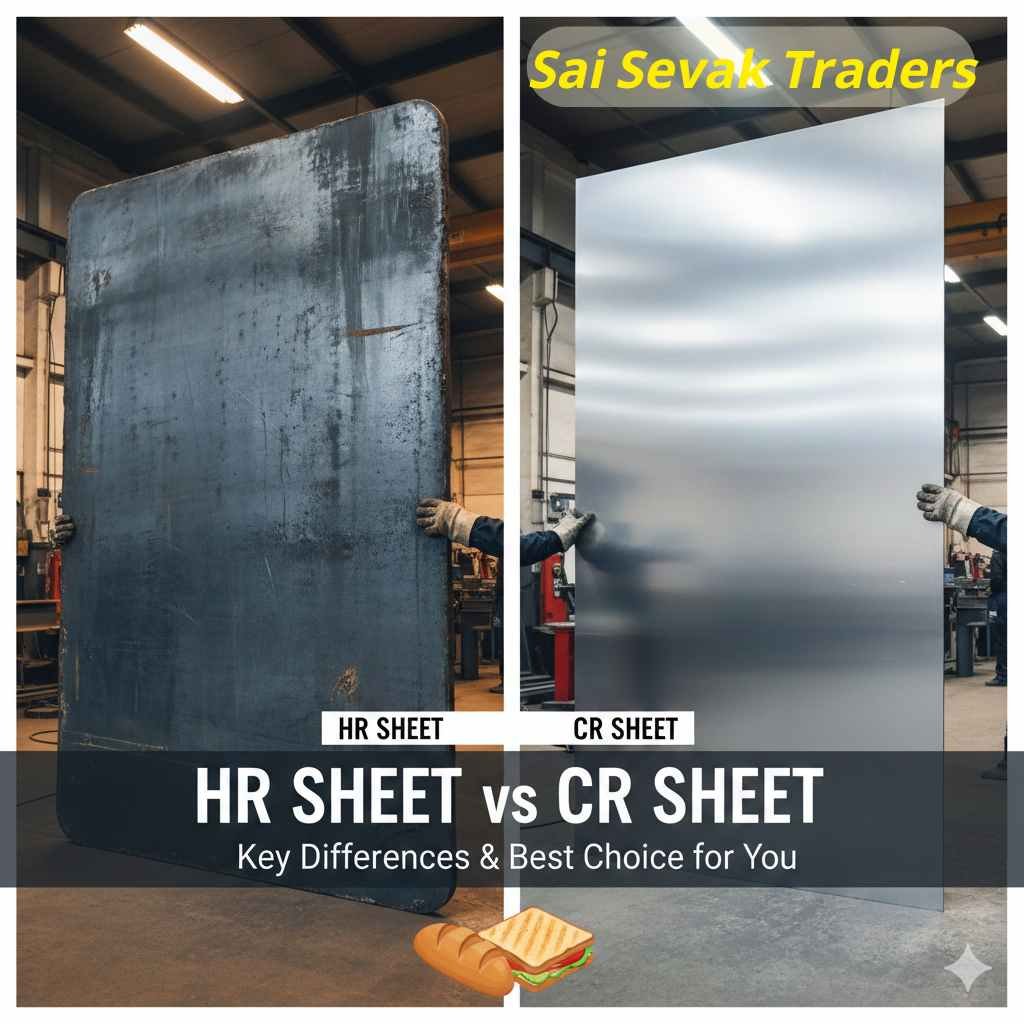
HR Sheet and CR Sheet Difference: Side-by-Side Comparison
Let’s get practical. Here’s what actually matters when you’re choosing between the two:
| Feature | HR Sheet | CR Sheet |
| Surface Finish | Rough, scaly, bluish-gray oxide layer | Smooth, shiny, clean appearance |
| Dimensional Tolerance | ±0.075″ typical | ±0.005″ precision |
| Strength | Standard strength | 20% stronger than HR |
| Edge Quality | Rounded, slightly rough | Sharp, well-defined |
| Cost | 10-20% cheaper | Premium pricing due to extra processing |
| Malleability | More ductile and formable | Harder, less flexible |
Hot Rolled vs Cold Rolled Steel Comparison: When to Use What?
Choose HR Sheets When:
- Budget matters more than looks – Construction sites don’t need Instagram-worthy steel
- You’re building structural components – I-beams, railroads, and agricultural equipment love HR
- Tight tolerances aren’t critical – A few millimeters won’t make or break your project
- You need better formability – Bending and shaping are easier with softer material
Real talk: If you’re fabricating a warehouse frame or agricultural machinery in Bhopal, an hr sheet supplier in bhopal like Sai Sevak Traders can hook you up with HR steel that’ll save you serious money without compromising structural integrity.
Choose CR Sheets When:
- Appearance counts – Appliances, automotive parts, and visible components
- Precision is non-negotiable – Aerospace components and mechanical parts demand tight specs
- You need extra strength – High-stress applications benefit from that 20% boost
- Surface preparation is expensive – Why pay for grinding when you can buy smooth?
HR vs CR Sheet Uses: Industry Applications That Actually Matter
HR Sheet Applications
- Construction: Steel buildings, structural beams, metal roofing
- Automotive: Truck frames, wheel rims, chassis components
- Industrial: Railcar parts, storage tanks, heavy machinery bases
- Agricultural: Tractor implements, grain storage bins
CR Sheet Applications
- Automotive: Body panels, door frames, hood assemblies
- Appliances: Refrigerator bodies, washing machine drums
- Furniture: Metal cabinets, filing systems, decorative elements
- Precision Parts: Gears, shafts, brackets requiring exact specifications
HR Sheet vs CR Sheet Mechanical Properties: The Numbers Don’t Lie
Let’s talk strength. HR sheets typically have a tensile strength of 400-550 MPa, while CR sheets push 550-700 MPa. That’s like comparing a reliable sedan to a sports car—both get you there, but one handles stress better.
Elongation (how much the material stretches before breaking) is another critical factor. HR steel offers 25-30% elongation, making it more forgiving during forming operations. CR steel sits around 15-20%, meaning it’s stronger but less flexible.
When working with an hr plate distributor in bhopal, these mechanical properties directly impact your project’s performance and longevity.
Which Is Better HR or CR Sheet? The Honest Answer
Here’s the truth nobody tells you: neither is universally “better.” It’s like asking whether a hammer or screwdriver is better—depends on what you’re building.
Go HR if: Cost efficiency, structural strength, and formability top your priority list. Most construction and industrial applications don’t need that mirror finish anyway.
Go CR if: You’re manufacturing consumer products, need precise dimensions, or require superior strength in a thinner gauge. That premium price often pays for itself in reduced secondary processing.
For projects comparing HR Sheet Plate vs. Cold Rolled Plate specifications, consider your end-use environment. Will it be painted? Welded? Load-bearing? These questions matter more than the steel type alone.
Common Mistakes When Choosing Between HR and CR Steel
- Picking CR for hidden structural work – You’re literally burying extra costs
- Using HR for precision assemblies – Those tolerance issues will haunt you during assembly
- Ignoring surface preparation costs – Sometimes CR’s higher upfront cost beats HR + grinding expenses
- Forgetting about welding behavior – CR’s internal stresses can cause post-weld distortion without proper treatment
FAQ: Your Burning Questions Answered
1. Can I paint HR steel directly?
Not recommended. That mill scale needs removal via pickling, sandblasting, or grinding first. Otherwise, your paint will flake off faster than you can say “rust bucket.”
2. Is CR steel always more expensive?
Typically 10-20% pricier due to extra processing. However, if you factor in machining time and surface prep, the total cost difference shrinks.
3. Which steel rusts faster?
Both rust at similar rates when exposed to moisture. The difference? CR’s smooth surface makes rust prevention coatings adhere better.
4. Can I weld both types easily?
HR steel welds more forgivingly. CR requires stress-relief annealing before welding to prevent warping—skip this step at your peril.
5. How do I identify HR vs CR visually?
HR has a rough, scaly, dark surface (sometimes bluish). CR looks smooth, shiny, and feels slightly oily.
Making Your Decision: A Practical Framework
Still stuck? Ask yourself these three questions:
- Does anyone see this steel? (Yes = lean CR | No = lean HR)
- Need precision tighter than ±0.05″? (Yes = CR | No = HR)
- Is budget your biggest constraint? (Yes = HR | No = consider CR)
The Bottom Line
The hr sheet vs cr sheet decision isn’t rocket science—it’s about matching material properties to your specific needs. HR steel delivers cost-effective strength for structural work, while CR steel provides precision and aesthetics for finished products.
Whether you’re sourcing from a local supplier in Bhopal or planning a nationwide project, understanding the steel manufacturing process behind HR and CR sheets helps you make smarter purchasing decisions. At Sai Sevak Traders, we’ve helped countless clients across India navigate these choices—because the right steel today means fewer headaches tomorrow.
Ready to order? Connect with Sai Sevak Traders — your trusted authorized steel distributor and dealer. Get expert guidance and genuine materials for your project. Contact us today