
Hey, if you’ve probably landed here because someone threw around terms like mild steel and carbon steel and you’re wondering: are they the same thing or totally different?
Short answer: Mild steel IS a type of carbon steel — but not all carbon steel is mild. Think of it like this: all dogs are animals, but not all animals are dogs. Same logic.
I’ve been supplying steel across India for the last 15 years (we’re Sai Sevak Traders, authorized steel distributors in Bhopal and pan-India), and trust me — 9 out of 10 customers ask me this exact question when they walk in. So let’s clear the confusion once and for all in plain English.
The One Thing That Changes Everything: Carbon Content
Steel = Iron + Carbon + tiny bits of other stuff.
The amount of carbon decides literally everything — strength, hardness, ductility, price, and how easy it is to weld or bend.
| Type | Carbon % | Nickname | Strength vs Ductility | Real-Life Feel |
| Mild Steel (Low-carbon) | 0.05 – 0.25% | The “friendly” steel | Moderate strength, super bendy & weldable | Like soft clay — easy to shape |
| Medium-carbon steel | 0.30 – 0.60% | The “balanced” one | Stronger, still somewhat bendy | Like thick leather |
| High-carbon steel | 0.61 – 1.00% | The “tough guy” | Very hard & strong, but brittle | Like hardened glass — sharp but cracks easy |
| Ultra-high-carbon | 1.25 – 2.00% | The “samurai” steel | Crazy hard, zero forgiveness | Like ceramic — amazing edge, snaps under side load |
So… Is Carbon Steel Stronger Than Mild Steel?
Yes — but only if we’re talking medium or high-carbon steel.
Mild steel (low-carbon steel) is the weakest of the carbon-steel family, but it’s also the most forgiving and cheapest.
Real numbers (average values):
- Mild steel (example grade: IS 2062, E250) → Tensile strength ≈ 410–450 MPa
- Medium-carbon (AISI 1045) → ≈ 600–800 MPa
- High-carbon (AISI 1095) → can cross 1000 MPa after heat treatment
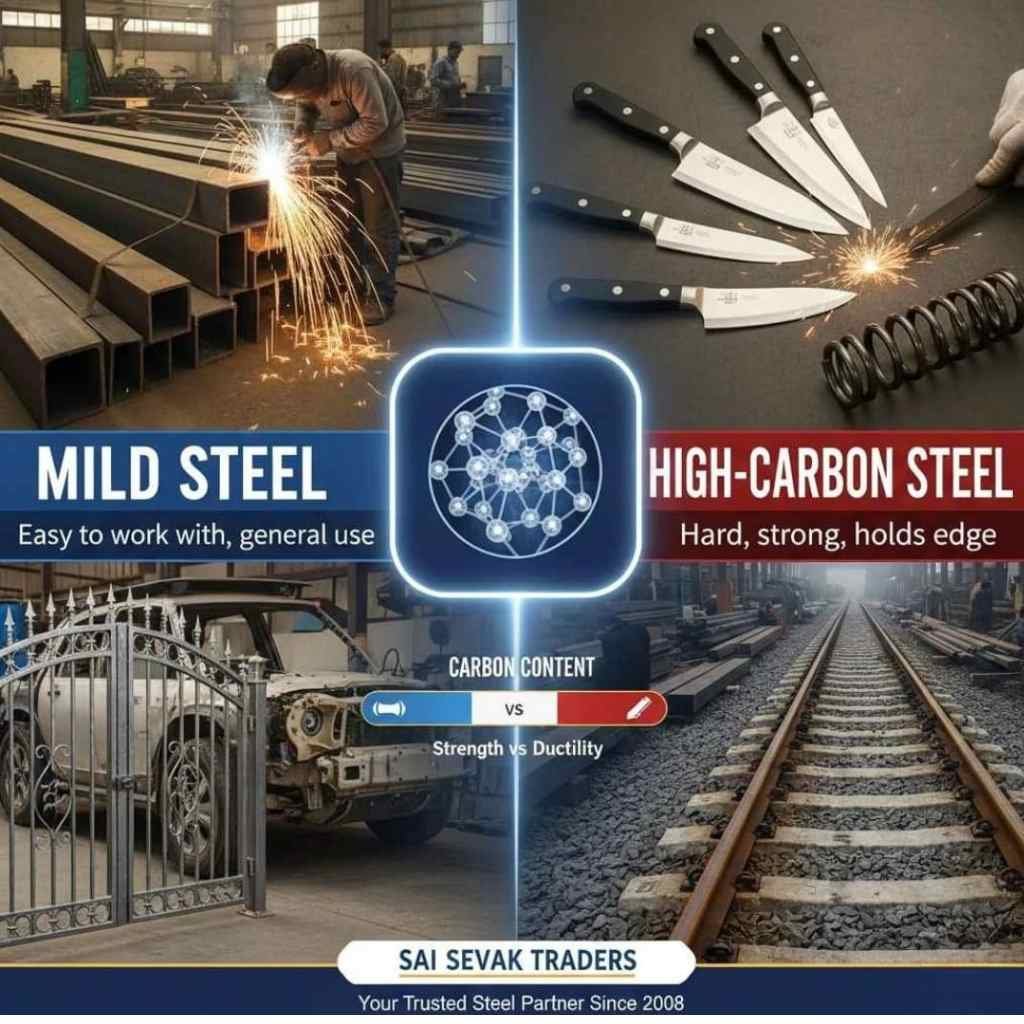
That’s why your kitchen knife is high-carbon and your car chassis is mild steel.
Properties of Carbon Steel vs Mild Steel – Quick Comparison Table
| Property | Mild Steel | Carbon Steel (Medium/High) |
| Strength | Moderate | High to Very High |
| Ductility & Formability | Excellent (bends without cracking) | Poor (can snap if bent cold) |
| Weldability | Super easy (even beginners can do it) | Needs pre-heating & special rods |
| Hardness | Soft (can be machined easily) | Hard (great for tools, bad for machining) |
| Price per ton (India 2025) | ₹52,000 – ₹58,000 | ₹65,000 – ₹1,10,000+ |
| Rust resistance | Poor (both rust equally fast) | Poor (same story) |
| Best for | Construction, pipes, sheets, gates | Knives, springs, gears, railway tracks |
Real-Life Examples I See Every Day in Bhopal
- A customer wants to build a warehouse → We give IS 2062 mild steel beams and channels. Cheap, easy to weld on site, and plenty strong enough.
- A knife manufacturer in Indore → Orders EN-8 or high-carbon spring steel because he needs razor sharpness that lasts.
- A trailer manufacturer → Uses mild steel for the chassis (bendable) but high-carbon for the axles (needs hardness).
Same project, two completely different steels.
How to Identify Mild Steel vs Carbon Steel in 30 Seconds (Workshop Tricks)
Spark Test (my favorite)
Mild steel → Long, straw-colored sparks with few bursts
High-carbon → Short, white sparks that explode like fireworks
File Test
Mild steel feels soft — file bites easily
High-carbon resists the file like it’s angry at you
Magnet Test (quick & dirty)
Both are magnetic, but austenitic stainless isn’t — useful to rule out stainless.
You can also check out the guide on : mild steel vs stainless steel
Can Mild Steel Be Made Harder?
Yes! We do it all the time for customers who want the best of both worlds.
Common methods:
- Case hardening (carburizing) → only surface becomes hard
- Flame / Induction hardening → selective areas
- Adding manganese (up to 1.65% in grades like IS 2062 E350) gives extra strength without losing weldability.
Where Do You Actually Use Each One in India?
Mild Steel (you’ll see this 90% of the time)
- Structural steel buildings & factories
- TMT bars (Fe415, Fe500)
- Automobile bodies
- Gates, grills, furniture
Higher Carbon Steel
- Railway tracks
- Cutting tools & chisels
- High-strength bolts
- Crane hooks & heavy shafts
Quick FAQ – Questions We Get Every Day at Sai Sevak Traders
1. Which is cheaper — mild steel or carbon steel?
A: Mild steel is always cheaper in India. Right now (Nov 2025), expect ₹4,000–₹8,000 per ton less than medium-carbon.
2. Can I weld high-carbon steel easily?
A: Not really. You need pre-heating, low-hydrogen rods, and post-weld heat treatment, otherwise it cracks.
3. Does carbon steel rust faster than mild steel?
A: Nope. Both rust at almost the same speed unless you add chromium (then it becomes stainless).
4. I’m confused — my supplier said “MS” and “CS” are the same. Is he lying?
A: Not lying — just lazy with words. Technically all mild steel is carbon steel, but in daily language “carbon steel” usually means medium or high-carbon.
Final Verdict — Which One Should You Pick?
- Budget project, lots of welding, bending, general fabrication → Go mild steel (IS 2062 E250 or E350)
- Need hardness, wear resistance, cutting edge → Go medium or high-carbon steel
Still confused? Drop your requirement in the chat or call us at Sai Sevak Traders — we’re authorized distributors for SAIL, JSW, Tata Steel and stock everything from 6 mm rounds to 600 mm beams.
Need a mild steel supplier in Bhopal or anywhere in India?
Let’s build something strong together!
Sai Sevak Traders – Your trusted steel partner since 2008.